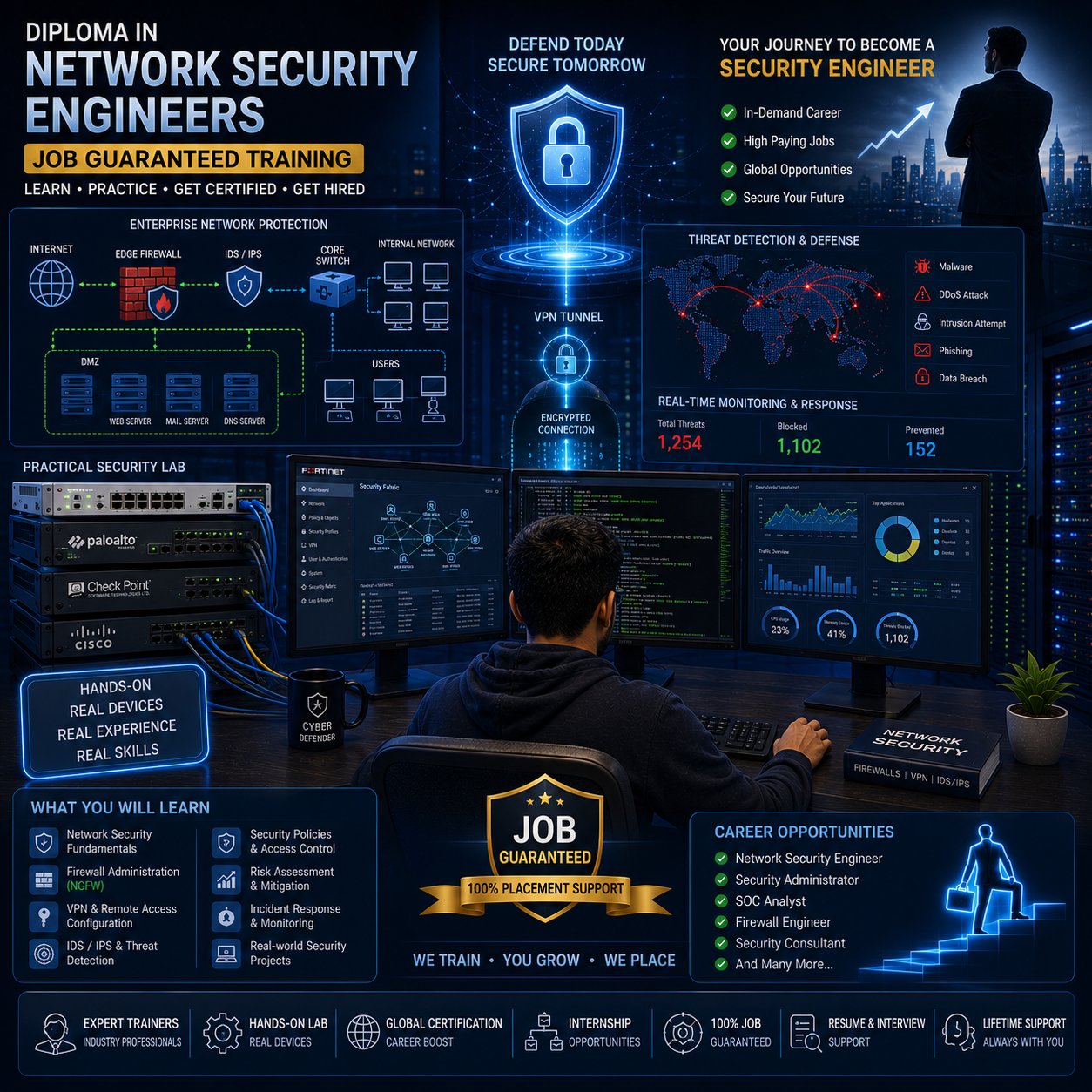
Diploma in Network Security Engineers Job Guaranteed Training
COURSE OVERVIEW
Advance your career with our 1-Year Network Security Engineer Diploma, designed to provide in-depth knowledge and hands-on skills across networking, advanced routing, VPNs, and next-generation firewall technologies. This program combines Cisco CCNA, CCNP Enterprise (ENCOR & ENARSI), network security foundations, advanced VPNs, and Fortinet, Checkpoint, and Palo Alto firewalls, ensuring you are prepared to secure and manage enterprise and ISP networks.

Course Curriculum
- Aspiring Network Security Engineers
- IT Professionals & System Administrators
- Recent Graduates & Career Switchers
- Networking and Cybersecurity Enthusiasts
- IT Support, NOC, and SOC Professionals
- Cisco Certification and Security Certification Seekers
- Basic computer literacy
- Fundamental networking knowledge (TCP/IP, subnets, routing)
- Familiarity with Windows/Linux operating systems
- Motivation to learn advanced network security concepts
- Basic understanding of IP addressing, routing, and firewall fundamentals
- Network Security Engineer
- Network Administrator
- Firewall Engineer
- SOC Analyst
- Security Operations Specialist
- VPN Engineer
- NOC Technician
- Enterprise Security Consultant
Modules Covered In This Diploma Course
- MODULE 1 : CCNA 200-301
- MODULE 2 : Cisco CCNP Enterprise Network Core Technologies (ENCOR)
- MODULE 3 : Cisco CCNP Enterprise Advanced Routing and Services (ENARSI)
- MODULE 4 : Cisco CCNP Security (SCORE)
- MODULE 5 : Cisco Certified Specialist - Network Security VPN
- MODULE 6 : Next-Generation Fortinet Fortigate Firewall
- MODULE 7 : Next-Generation Checkpoint Firewall
- MODULE 8 : Next-Generation Palo Alto Firewall (PCNSA/PCNSE)
- MODULE 9 : Interview Preparation & Grooming Sessions
Details Of Every Course
MODULE 1 : CCNA 200-301
- Get Started with Cisco Command-Line Interface (CLI)
- Observe How a Switch Operates
- Perform Basic Switch Configuration
- Implement the Initial Switch Configuration
- Inspect TCP/IP Applications
- Configure an Interface on a Cisco Router
- Configure and Verify Layer 2 Discovery Protocols
- Implement an Initial Router Configuration
- Configure Default Gateway
- Explore Packet Forwarding
- Troubleshoot Switch Media and Port Issues
- Troubleshoot Port Duplex Issues
- Configure Basic IPv6 Connectivity
- Configure and Verify IPv4 Static Routes
- Configure IPv6 Static Routes
- Implement IPv4 Static Routing
- Implement IPv6 Static Routing
- Configure VLAN and Trunk
- Troubleshoot VLANs and Trunk
- Configure a Router on a Stick
- Implement Multiple VLANs and Basic Routing Between the VLANs
- Configure and Verify Single-Area OSPF
- Configure and Verify EtherChannel
- Improve Redundant Switched Topologies with EtherChannel
- Configure and Verify IPv4 ACLs
- Implement Numbered and Named IPv4 ACLs
- Configure a Provider-Assigned IPv4 Address
- Configure Static NAT
- Configure Dynamic NAT and Port Address Translation (PAT)
- Implement PAT
- Log into the WLC
- Monitor the WLC
- Configure a Dynamic (VLAN) Interface
- Configure a DHCP Scope
- Configure a WLAN
- Define a Remote Access Dial-In User Service (RADIUS) Server
- Explore Management Options
- Explore the Cisco DNA Center
- Configure and Verify NTP
- Configure System Message Logging
- Create the Cisco IOS Image Backup
- Upgrade Cisco IOS Image
- Configure WLAN Using Wi-Fi Protected Access 2 (WPA2) Pre-Shared Key (PSK) Using the GUI
- Secure Console and Remote Access
- Enable and Limit Remote Access Connectivity
- Secure Device Administrative Access
- Configure and Verify Port Security
- Implement Device Hardening
MODULE 2 : Cisco CCNP Enterprise Core Technologies (ENCOR)
- Understand Enterprise Network Architecture
- Explore Virtualization Technologies in Networking
- Implement Enterprise Infrastructure Services
- Configure and Manage Advanced Switching and Routing
- Apply Quality of Service (QoS) for Enterprise Applications
- Perform Network Assurance and Monitoring
- Integrate Security in Enterprise Networks
- Automate Network Tasks with Programmability Tools
- Troubleshoot Common Enterprise Network Issues
MODULE 3 : Cisco CCNP Enterprise Advanced Routing and Services (ENARSI)
- Implement Advanced Layer 3 Routing Technologies
- Configure and Troubleshoot EIGRP
- Deploy and Optimize OSPFv2 and OSPFv3
- Implement and Troubleshoot BGP in Enterprise Networks
- Explore Route Redistribution and Filtering
- Configure VPN Technologies (DMVPN, FlexVPN, MPLS)
- Apply Infrastructure Security Best Practices
- Deploy Advanced Infrastructure Services
- Troubleshoot Routing Protocols and VPNs
MODULE 4 : Cisco CCNP Security (SCORE)
- Understand Modern Security Concepts and Threat Defense
- Implement Advanced Network Security Measures
- Secure Enterprise Cloud Deployments
- Apply Content Security Solutions (Email, Web, File Security)
- Deploy Endpoint Protection and Malware Defense
- Implement Secure Network Access Controls
- Monitor Visibility and Enforce Security Policies
- Troubleshoot Security Incidents in Enterprise Networks
MODULE 5 : Cisco Certified Specialist-Network Security VPN
- Configure Site-to-Site VPNs on Routers and Firewalls
- Implement Remote Access VPN Solutions
- Troubleshoot VPNs Using ASDM and CLI
- Understand and Deploy Secure Communication Architectures
- Integrate VPN Solutions in Enterprise Environments
- Apply Security Policies for Remote Connectivity
MODULE 6 : Next-Generation Fortinet FortiGate Firewall
- Perform FortiGate Lab Setup and Initial Configuration
- Configure Basic and Advanced Routing (Static, OSPF, BGP, IS-IS)
- Implement Security Policies and NAT (IPv4 & IPv6)
- Configure Site-to-Site VPN with Multi-Vendor Integration
- Deploy High Availability (Active-Passive & Active-Active)
- Integrate Fortinet Single Sign-On (FSSO)
- Implement Software-Defined WAN (SD-WAN)
- Configure SSL VPN for Secure Remote Access
- Apply Security Profiles (Antivirus, Web Filter, App Control, File Filter)
- Use Centralized Logging and Management with FortiAnalyzer & FortiManager
MODULE 7 : Next-Generation Check Point Firewall
- Introduction to Check Point Firewalls and Security Concepts
- Explore Check Point Gaia Operating System
- Create Check Point Labs in EVE-NG
- Implement IPv4 Static & Default Routing
- Configure and Manage Security Zones
- Apply IPv4 NAT (Static & Dynamic)
- Implement Site-to-Site VPN with IKEv2 on Gaia
- Configure Threat Prevention (IPS, Anti-Bot, Anti-Virus)
- Implement HTTPS Inspection and SSL Decryption
- Deploy ClusterXL for High Availability
MODULE 8 : Next-Generation Palo Alto Firewall (PCNSA/PCNSE)
- Introduction to Palo Alto Networks Security Platform
- Explore Firewall Architecture and Security Models
- Configure Interface Types and Security Zones
- Implement Advanced Routing Techniques
- Create and Manage Security and NAT Policies
- Use Application Identification and Control (App-ID)
- Integrate User Identification (User-ID) with Directory Services
- Configure Site-to-Site VPN for Enterprise Security
- Implement Threat Prevention and Centralized Logging
- Apply Next-Generation Security Best Practices
MODULE 9 : Interview Preparation and Grooming Sessions (Network Security)
- Resume Writing and LinkedIn Profile Optimization
- Conduct Mock HR and Technical Interview Sessions
- Practice Scenario-Based Cybersecurity Troubleshooting
- Develop Professional Communication and Workplace Etiquette
- Participate in Group Discussions and Team Collaboration
- Hands-On Resume Building and LinkedIn Workshop
- Mock Interview Simulations for Job Readiness
- Case Study-Based Problem-Solving Exercises
- Network Engineer
- Network Administrator
- Systems Administrator
- Network Analyst
- Security Engineer
- Cybersecurity Analyst
- Data Center L1 Engineer
- Network Operations Center (NOC) Technician
- Network Support Engineer
- L1 Security Engineer
- Security Operations Center (SOC) Technician
- Technical Support Specialist
- Firewall Engineer
- Network Monitoring Engineer
- Mid-Level Information Security Auditor
- Cybersecurity Auditor
- Security Administrator
- IT Security Administrator
- Cyber Defense Analyst
- Vulnerability Assessment Analyst
- Warning Analyst
- Information Security Analyst 1
- Security Analyst L1
- Infosec Security Administrator
- Cybersecurity Analyst Level 1, Level 2, & Level 3
- Network Security Engineer
- SOC Security Analyst
- Security Analyst
- Network Engineer
- Senior Security Consultant
- Information Security Manager
- Senior SOC Analyst
- Solution Architect
- Cybersecurity Consultant
MODULE 1 : CCNA 200-301 Labs
- Get Started with Cisco CLI
- Perform Basic Switch Configuration
- Implement Initial Switch Configuration
- Configure Interface on Cisco Router
- Configure and Verify Layer 2 Discovery Protocols
- Implement Initial Router Configuration
- Configure Default Gateway
- Troubleshoot Switch Media and Port Issues
- Troubleshoot Port Duplex Issues
- Configure Basic IPv6 Connectivity
- Configure and Verify IPv4 Static Routes
- Configure IPv6 Static Routes
- Implement IPv4/IPv6 Static Routing
- Configure VLAN and Trunk
- Troubleshoot VLANs and Trunk
- Configure Router on a Stick
- Implement Multiple VLANs and Routing Between VLANs
- Configure and Verify Single-Area OSPF
- Configure and Verify EtherChannel
- Configure and Verify IPv4 ACLs
- Implement Numbered and Named IPv4 ACLs
- Configure Provider-Assigned IPv4 Address
- Configure Static NAT
- Configure Dynamic NAT and PAT
- Implement PAT
- Log into the WLC
- Monitor the WLC
- Configure VLAN Interface
- Configure DHCP Scope
- Configure WLAN
- Define RADIUS Server
- Configure and Verify NTP
- Configure System Message Logging
- Create Cisco IOS Image Backup
- Upgrade Cisco IOS Image
- Configure WLAN with WPA2 PSK (GUI)
- Secure Console and Remote Access
- Enable & Limit Remote Access Connectivity
- Secure Device Administrative Access
- Configure & Verify Port Security
MODULE 2 : Cisco CCNP ENCOR Labs
- Understand Enterprise Network Architecture
- Explore Virtualization Technologies in Networking
- Implement Enterprise Infrastructure Services
- Configure and Manage Advanced Switching and Routing
- Apply Quality of Service for Enterprise Applications
- Perform Network Assurance and Monitoring
- Integrate Security in Enterprise Networks
- Automate Network Tasks with Programmability Tools
- Troubleshoot Common Enterprise Network Issues
MODULE 3 : Cisco CCNP ENARSI Labs
- Implement Advanced Layer 3 Routing Technologies
- Configure and Troubleshoot EIGRP
- Deploy and Optimize OSPFv2 and OSPFv3
- Implement and Troubleshoot BGP in Enterprise Networks
- Explore Route Redistribution and Filtering
- Configure VPN Technologies DMVPN, FlexVPN, MPLS
- Apply Infrastructure Security Best Practices
- Deploy Advanced Infrastructure Services
- Troubleshoot Routing Protocols and VPNs
MODULE 4 : Cisco CCNP Security (SCORE) Labs
- Understand Modern Security Concepts and Threat Defense
- Implement Advanced Network Security Measures
- Secure Enterprise Cloud Deployments
- Apply Content Security Solutions Email, Web, File Security
- Deploy Endpoint Protection and Malware Defense
- Implement Secure Network Access Controls
- Monitor Visibility and Enforce Security Policies
- Troubleshoot Security Incidents in Enterprise Networks
MODULE 5 : Cisco Certified Specialist-Network Security VPN Labs
- Configure Site-to-Site VPNs on Routers and Firewalls
- Implement Remote Access VPN Solutions
- Troubleshoot VPNs Using ASDM and CLI
- Understand and Deploy Secure Communication Architectures
- Integrate VPN Solutions in Enterprise Environments
- Apply Security Policies for Remote Connectivity
MODULE 6 : Next-Generation Fortinet FortiGate Firewall Labs
- Perform FortiGate Lab Setup and Initial Configuration
- Configure Basic and Advanced Routing Static, OSPF, BGP, IS-IS
- Implement Security Policies and NAT IPv4 and IPv6
- Configure Site-to-Site VPN with Multi-Vendor Integration
- Deploy High Availability Active-Passive and Active-Active
- Integrate Fortinet Single Sign-On FSSO
- Implement Software-Defined WAN SD-WAN
- Configure SSL VPN for Secure Remote Access
- Apply Security Profiles Antivirus, Web Filter, App Control, File Filter
- Use Centralized Logging and Management with FortiAnalyzer and FortiManager
MODULE 7 : Next-Generation Check Point Firewall Labs
- Introduction to Check Point Firewalls and Security Concepts
- Explore Check Point Gaia Operating System
- Create Check Point Labs in EVE-NG
- Implement IPv4 Static and Default Routing
- Configure and Manage Security Zones
- Apply IPv4 NAT Static and Dynamic
- Implement Site-to-Site VPN with IKEv2 on Gaia
- Configure Threat Prevention IPS, Anti-Bot, Anti-Virus
- Implement HTTPS Inspection and SSL Decryption
- Deploy ClusterXL for High Availability
MODULE 8 : Next-Generation Palo Alto Firewall (PCNSA/PCNSE) Labs
- Introduction to Palo Alto Networks Security Platform
- Explore Firewall Architecture and Security Models
- Configure Interface Types and Security Zones
- Implement Advanced Routing Techniques
- Create and Manage Security and NAT Policies
- Use Application Identification and Control App-ID
- Integrate User Identification User-ID with Directory Services
- Configure Site-to-Site VPN for Enterprise Security
- Implement Threat Prevention and Centralized Logging
- Apply Next-Generation Security Best Practices
Upon completion, students are prepared for vendor and professional certification:
- CCNA 200-301
- CCNP ENCOR 350-401
- CCNP ENARSI 300-410
- CCNP Security (SCORE) 300-208
- Cisco Certified Specialist -Network Security VPN 300-730 SNCF
- Fortinet NSE 4-FortiGate Security
- Fortinet NSE 5-FortiManager & FortiAnalyzer (optional)
- Check Point CCSA-Check Point Certified Security Administrator
- Check Point CCSE-Check Point Certified Security Expert
- Palo Alto PCNSA-Palo Alto Networks Certified Network Security Administrator
- Palo Alto PCNSE-Palo Alto Networks Certified Network Security Engineer
Mark Jukarberg
UX Design LeadDorem ipsum dolor sit amet, consectetur adipiscing elit, sed do eiusmod tempor incididunt ut labore et dolore magna aliqua Quis ipsum suspendisse ultrices gravida. Risus commodo viverra maecenas accumsan.