Preloader
  • Follow Us On :
Request Demo Class Join Free Seminar
Beginner to Advanced Official Curriculum · Network Administration Exam Prep

Network Administration of IT Infrastructure

Gain end-to-end expertise in network operations and infrastructure management through our multi-vendor, hands-on, and job-oriented training program. This industry-aligned diploma prepares you for a successful career in  Network Engineering, ISP technical support, and fiber optic network management.

★★★★★ N/A (0 ratings) · 200 students trained
176 hrs training
88 classes 
Advanced level
Physical + Online
Network Administration of IT Infrastructure course banner
BDT 15,000 BDT 20,000
Installment payment available Pay in 2-3 parts · bKash · Nagad · Bank Transfer
200
Students trained
80%
Exam pass rate
10+ yrs
Training experience
N/A ★
Student satisfaction
Why choose LearnerUp IT
Why choose this course?

Everything you need to get certified

Cisco CCNA 200-301 Training
MikroTik (MTCNA, MTCRE) & OLT Technologies
Juniper JNCIA-Junos Fundamentals
Network Administration Special Module
Multi-Vendor Networking Skills
Hands-On Enterprise & ISP Labs
Interview Preparation & Career Grooming
3-Month ISP Internship Program

Course overview

Gain end-to-end expertise in network operations and infrastructure management through our multi-vendor, hands-on, and job-oriented training program. This industry-aligned diploma prepares you for a successful career in  Network Engineering, ISP technical support, and fiber optic network management. From Cisco to MikroTik, Juniper, and Optical Line Terminals, this diploma covers the full spectrum of networking technologies essential for today's IT infrastructure.
Who should enroll

Ideal candidates

  • Network Support and Field Engineers seeking multi-vendor skills
  • Recent Graduates targeting telecom and ISP roles
  • IT Professionals aiming to specialize in ISP and fiber networks
  • Aspiring Network Engineers and Network Operations Technicians

Prerequisites

  • Familiarity with command line interfaces is a plus but not required
  • Motivation to learn and grow professionally
  • Fundamental networking knowledge (IP addressing, basic routing)
  • Basic computer and internet skills

Career outcomes

Network Engineer / Network Administrator
Network Support Engineer
Junior Network Administrator
ISP Technical Support Specialist
Network Monitoring Technician
Fiber Optic Network Technician
Network Operations Analyst
Multi-Vendor Network Specialist (Cisco, MikroTik, Juniper, OLT)
COURSE 01: Cisco Certified Network Associate-CCNA (200-301)
Cisco Certified Network Associate-CCNA (200-301)

MODULE 1: Network Fundamentals

  • Network Fundamentals Overview
  • Network Components
  • Network Topology Architectures
  • Physical Interface & Cabling
  • Interface & Cable Issues
  • TCP vs UDP
  • IPv4 Addressing & Subnetting
  • Private IPv4 Addressing
  • IPv6 Addressing & Prefix
  • IPv6 Address Types
  • Verify IP Parameters
  • Wireless Principles
  • Virtualization Fundamentals
  • Switching Concept

MODULE 2: Network Access

  • VLAN Configuration
  • Interswitch Connectivity
  • Layer 2 Discovery Protocols
  • EtherChannel (LACP)
  • Rapid PVST+ STP
  • Cisco Wireless Architectures
  • WLAN Physical Infrastructure
  • Device Management Access
  • WLAN GUI Configuration

MODULE 3: IP Connectivity

  • Routing Table Components
  • Router Forwarding Decision
  • Static Routing (IPv4 & IPv6)
  • Single Area OSPFv2
  • First Hop Redundancy Protocols (Concepts)

MODULE 4: IP Services

  • NAT (Static & Pools)
  • NTP Client & Server
  • Role of DHCP and DNS
  • SNMP
  • Syslog
  • Configure and Verify DHCP Client and Relay
  • QoS PHB
  • SSH Configuration
  • TFTP/FTP

MODULE 5: Security Fundamentals

  • Security Concepts
  • Security Program Elements
  • Device Access Control
  • Password Policies
  • IPsec VPN Concepts
  • ACL Configuration & Verification
  • Layer 2 Security
  • AAA Concepts
  • Wireless Security (WPA/WPA2/WPA3)
  • WLAN WPA2 PSK

MODULE 6: Automation & Programmability

  • Automation in Network Management
  • Traditional vs Controller-Based Networking
  • SD Architecture
  • AI & Machine Learning
  • REST APIs
  • Ansible & Terraform
  • JSON Component
COURSE 02: MikroTik Certified Network Associate (MTCNA)
MikroTik Certified Network Associate (MTCNA)

Module 1: Introduction

  • About MikroTik
  • First Time Accessing the Router
  • RouterOS Command Line Interface (CLI)
  • RouterOS CLI Principles
  • Initial Configuration (Internet Access)
  • Upgrading RouterOS
  • Router Identity
  • Manage RouterOS Logins
  • Manage RouterOS Services
  • Managing Configuration Backups
  • Resetting a RouterOS Device
  • Reinstalling a RouterOS Device (Netinstall)
  • RouterOS License Levels
  • Sources of Additional Information
  • Module 1 Laboratory

Module 2: DHCP

  • DHCP Server and Client
  • Address Resolution Protocol (ARP)
  • Module 2 Laboratory

Module 3: Bridging

  • Bridging overview
  • Bridge wireless networks
  • Module 3 laboratory

Module 4: Routing

  • Routing Overview
  • Static Routing
  • Module 4 Laboratory

Module 5: Wireless

  • 802.11a/b/g/n/ac Concepts
  • Setup a Simple Wireless Link
  • Wireless Security and Encryption
  • Monitoring Tools
  • Module 5 Laboratory

Module 6: Firewall

  • Firewall Principles
  • Firewall Filter in Action
  • Basic Address Lists
  • Source NAT
  • Destination NAT
  • FastTrack
  • Module 6 Laboratory

Module 7: QoS

  • Simple Queue
  • One Simple Queue for the Whole Network (PCQ)
  • Module 7 Laboratory

Module 8 Tunnels

  • PPP Settings
  • IP Pool
  • Secure Local Network
  • Point-to-Point Addresses
  • Secure Remote Network Communication
  • Module 8 Laboratory

Module 9: Misc

  • RouterOS Tools
  • Monitoring
  • Contacting Support
  • Module 9 Laboratory
COURSE 03: MikroTik Certified Routing Engineer(MTCRE)
MikroTik Certified Routing Engineer(MTCRE)

Module 1: Static Routing

  • More specific routes
  • ECMP
  • How to force gateway over specific interface
  • Gateway reachability check and route distance
  • Routing mark and route policy
  • Recursive next-hop and scope/target-scope usage
  • Module 1 Laboratory

Module 2: Point to Point Addressing

  • Point-to-point address configuration
  • Module 2 laboratory

Module 3: VPN

  • What is VPN?
  • Different Types of VPN
  • Site-to-Site Connectivity with Tunnels
  • VLAN and Its Usage
  • QinQ Implementation
  • VLAN and Managed Switch
  • VLAN and Switch Chip Configuration on RouterBOARDs
  • Module 3 Laboratory

Module 4: OSPF

  • What is OSPF?
  • How OSPF Protocol Works
  • OSPF Network Structure
  • OSPF Neighbors and Neighbor States (DR and BDR Election)
  • External Route Distribution Methods (Type 1, Type 2)
  • Interface Cost and Interface Types (Broadcast, NBMA, etc.)
  • SPT Calculation Algorithm
  • OSPF and Multicast (Problems with NBMA)
  • Stub, NSSA and Area Ranges (Route Aggregation)
  • Virtual Links, Usage and Limitations
  • OSPF Routing Filters and Limitations
  • Module 4 Laboratory
COURSE 04: Optical Line Terminal (OLT)
Optical Line Terminal (OLT)

Module 01: FTTx & PON Technology Fundamentals

  • What FTTx?
  • Advantages of the FTTx network.
  • What is PON/GPON/EPON Technology?
  • Difference between GPON and EPON?

Module 02: Optical Fiber Design & Network Planning

  • Optical Fiber Diagram of FTTx Network.
  • Budget calculation of Optical Fiber.
  • Optical Fiber Splitting Ratio
  • Wavelength plans.

Module 03: OLT Core Configuration & Service Deployment

  • OLT Basic Configuration.
  • ONU authentication Manual.
  • OLT VLAN Configuration.
  • OLT Remote management, ONU Auto Configuration.
  • PON Port Protection, LACP/RSTP Configuration, NTP/SNMP/ACL/IGMP Service Enable.
  • OLT Upgrade, Configuration File Backup.

Module 04: ONU Configuration & Customer Access Management

  • ONU Vlan Configuration.
  • ONU Bandwidth Managed.
  • ONU to ONU User connection.
  • Wi-Fi ONU Configuration.

Module 05: OLT Monitoring, Troubleshooting & Maintenance

  • OLT Log analysis.
  • PON and ONU Power checking.
  • Loopback detection and DHCP Snooping checking.
  • OLT Logging User Management
COURSE 05: Juniper Network Associate (JNCIA-Junos)
Juniper (JNCIA-Junos)

Module 01: Networking Fundamentals

  • Collision domains and broadcast domains
  • Function of routers and switches
  • Ethernet networks
  • Layer 2 addressing, including address resolution
  • Layer 3 / IP addressing, including subnet masks
  • IPv4 / IPv6
  • Subnetting and supernetting
  • Decimal to binary conversion
  • Longest match routing
  • CoS
  • Connection-oriented vs. connectionless protocols

Module 02: Junos OS Fundamentals

  • Software architecture
  • Control and forwarding planes
  • Routing engine and packet-forwarding engine
  • Transit traffic processing
  • Exception traffic

Module 03: User Interfaces

  • CLI functionality
  • CLI modes
  • CLI navigation
  • CLI Help
  • Filtering output
  • Active vs. candidate configuration
  • Reverting to previous configurations
  • Modifying, managing, and saving configuration files
  • Viewing, comparing, and loading configuration files
  • J-Web (core/common functionality only)

Module 04: Configuration Basics

  • Factory-default state
  • Initial configuration
  • User accounts
  • Login classes
  • User authentication methods
  • Interface types and properties
  • Configuration groups
  • Additional initial configuration elements, such as Network Time Protocol (NTP), SNMP, system log
  • Configuration archival
  • Logging and tracing
  • Rescue configuration
  • Describe how to configure basic components of a Junos device

Module 05: Operational Monitoring and Maintenance

  • Show commands
  • Monitor commands
  • Interface statistics and errors
  • Network tools, such as ping, traceroute, telnet, SSH, etc.
  • Junos OS installation and upgrades
  • Powering on and shutting down Junos devices
  • Root password recovery
  • Describe monitoring or maintenance procedures for a Junos device

Module 06: Routing Fundamentals

  • Traffic forwarding concepts
  • Routing tables
  • Routing vs. forwarding tables
  • Route preference
  • Routing instances
  • Static routing
  • Advantages of and use cases for dynamic routing protocols
  • Describe how to configure or monitor basic routing elements for a Junos device

Module 07: Routing Policy and Firewall Filters

  • Default routing policies
  • Import and export policies
  • Routing policy flow
  • Effect of policies on routes and routing tables
  • Policy structure and terms
  • Policy match criteria, match types, and actions
  • Firewall filter concepts
  • Filter structure and terms
  • Filter match criteria and actions
  • Effect of filters on packets
  • Unicast reverse-path-forwarding (RPF)
  • Describe how to configure or monitor routing policies and firewall filters on a Junos device
COURSE 06: Special Module ,Interview Preparation and Grooming Sessions
Special Module ,Interview Preparation and Grooming Sessions

MODULE 01 : Network Administration Special Module 

  • Network Infrastructure Components (Servers, Routers, Firewalls)
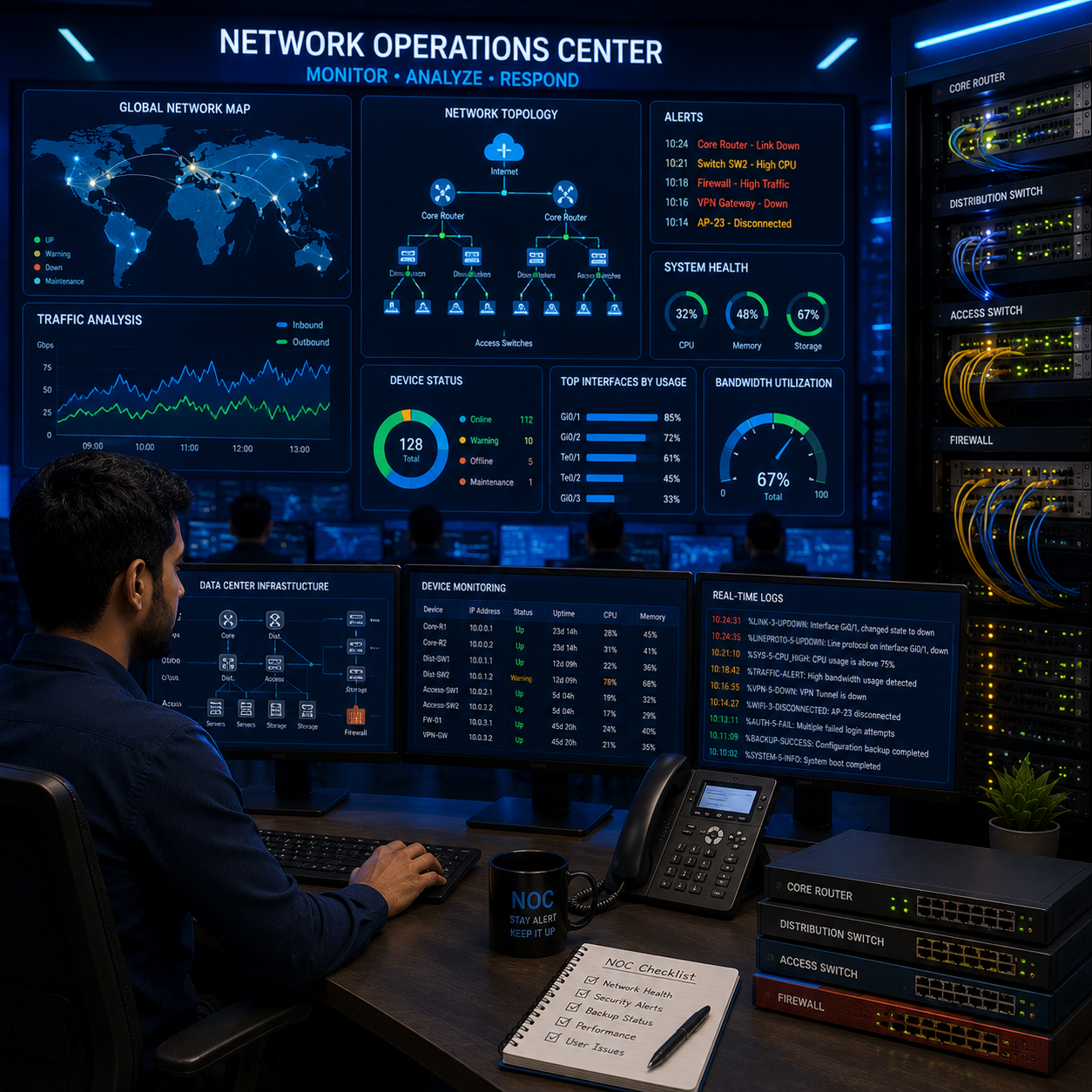
  • Network Monitoring Tools (Nagios, Zabbix, PRTG, SolarWinds)
  • Incident Management & Escalation Process
  • SLA, KPIs & Reporting Practices
  • Ticketing Systems (Jira, ServiceNow)
  • Security Awareness for Network Teams
  • Documentation & Communication Skills
  • Interview Preparation & Grooming
  • Resume Writing for Networking Careers
  • Common Technical & HR Interview Questions
  • Soft Skills & Communication Development
  • Career Guidance & ISP Market Trends
  • LinkedIn Optimization & Personal Branding

MODULE 02 : Interview Preparation and Grooming Sessions 

  • LinkedIn Optimization & Personal Branding
  • Career Guidance & ISP Market Trends
  • Soft Skills & Communication Development
  • Common Technical & HR Interview Questions
  • Resume Writing for Networking Careers
Internship 07: 3-Month ISP Internship Program
3-Month ISP Internship Program

3-Month ISP Internship Program

Nur Hossen
Nur Hossen
Head Of Department

With over 16 years of experience in the information technology field, I have built a strong specialization in banking technology and have worked with a wide range of corporate groups and government sectors, including my current role serving the Ministry of Defense in Kuwait.My expertise spans across systems security, information systems auditing, data center management, and IT project management. I am deeply committed to delivering secure, scalable, and efficient technology solutions tailored to organizational needs.

Windows system Administration

More instructors at LearnerUp IT

Kushal Kabi
Kushal Kabi
Sr. Technical Trainer
Windows system Administration
Abdullah Al Mahbub
Abdullah Al Mahbub
Sr. Technical Trainer
Windows system Administration
Razya Akter
Razya Akter
Sr. Technical Trainer
Windows system Administration
View all instructors at LearnerUp IT →
N/A
★★★★★
0 ratings
5★
0
4★
0
3★
0
2★
0
1★
0

Leave a Review

Review Submitted Successfully

Thank you for sharing your experience with LearnerUp IT. Your review will be visible after approval.

What kind of support will I receive during the course?
LearnerUp provides end-to-end support throughout your learning journey. Students receive guidance from certified instructors, access to study materials and hands-on labs, and dedicated academic and technical assistance. Career support, including CV building, interview preparation, and placement assistance, is also available for diploma and job-guarantee programs.
What types of courses does LearnerUp offer?

LearnerUp delivers training across five specialized departments:

  • Network Administration (CCNA, CCNP, MikroTik, Juniper, OLT, Infrastructure Diploma)
  • Windows System Administration (Windows Server, PowerShell, Infrastructure Diplomas)
  • Linux System Administration (RHCSA, RHCE, Infrastructure Diplomas)
  • Security Administration (Firewalls, CEH, Penetration Testing, Security Diplomas)
  • Cloud Administration (AWS, Azure, Cloud Infrastructure Diplomas)
Do the job-guarantee programs guarantee a job for all students?
Our Job-Guarantee Diploma Programs are designed to make you industry-ready through practical labs, real-world projects, and interview preparation. While no institute can guarantee employment for every student, LearnerUp ensures robust placement assistance, career mentorship, and industry connections to maximize your chances of securing a job.
Are there Scholarship courses available?

Yes. LearnerUp provides several scholarship-based courses to help students start their IT journey:

  • CCNA Crush Course
  • MTCNA Crush Course
  • IT Support & Services
  • Network Engineering Essentials
  • Microsoft Windows Server Engineering Essentials
  • Red Hat Linux Server Engineering Essentials
  • Security Engineering Essentials
Does LearnerUp provide free demo classes?
Yes. LearnerUp offers free demo classes so you can experience our teaching style, lab facilities, and course structure before making a decision.
Are the instructors at LearnerUp certified?
Yes. All our trainers are industry-certified professionals (Cisco, Red Hat, Microsoft, AWS, EC-Council, MikroTik, etc.) with extensive real-world experience. They combine certification expertise with practical insights to prepare you for both exams and job roles.
Does LearnerUp offer installment options?
Yes. To make learning accessible, we allow students to pay in convenient installments across all certification and diploma programs.
Who should enroll in LearnerUp's job-guarantee courses?

Our job-guarantee diploma programs are best suited for:
  • Fresh graduates aiming to start an IT career
  • Polytechnic, diploma, or engineering students
  • Professionals seeking a career switch into IT
  • Learners who want structured, career-oriented training with placement support
Do they offer corporate or customized training programs?
Yes. LearnerUp delivers corporate and customized training programs tailored for businesses. We specialize in workforce upskilling in networking, security, cloud, and system administration to meet organizational requirements.