Network Engineering Essentials
COURSE OVERVIEW
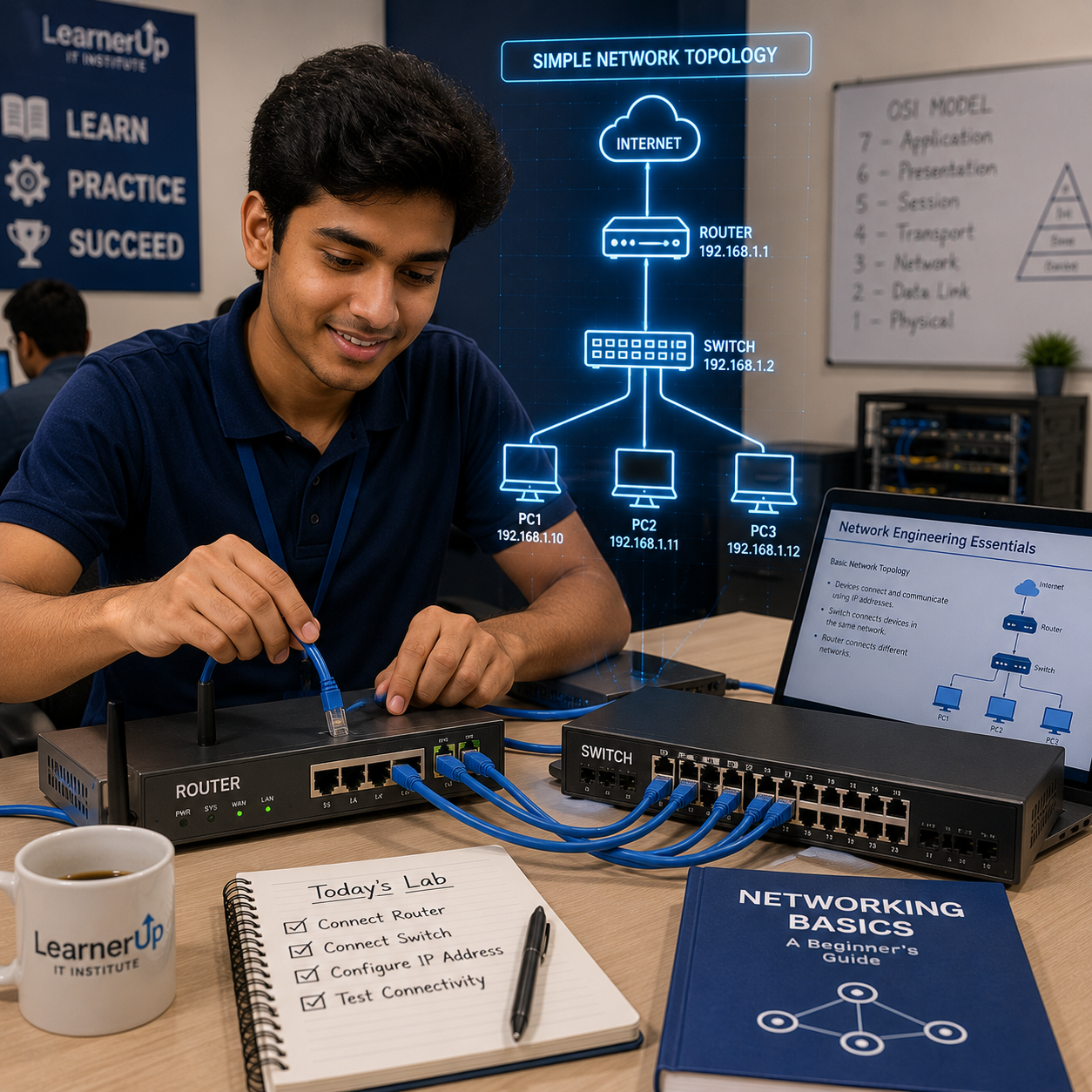
The Network Engineering Essentials course offers a comprehensive introduction to foundational and intermediate networking concepts essential for a career in network engineering. This course covers theory and practical labs to build the skills needed for real-world networking environments and certification preparation.
Course Curriculum
- Beginners seeking to start a career in IT or network engineering
- IT support staff wanting to solidify foundational networking knowledge
- Students preparing for certifications like CCNA, MTCNA, or CompTIA Network+
- Job seekers targeting roles such as Network Technician, Junior Network Engineer, or IT Support Engineer
- Basic computer literacy
- Familiarity with hardware components
- No prior networking experience required
- Network Support Technician
- IT Support Executive
- Junior Network Engineer
- Helpdesk Technician
- Network Operations Center (NOC) Operator
- Field Networking Technician
THEORY MODULES:
- Types of Computing Devices: IoT, Network Printer, PC, Laptop, Smart Device, Router, Switch, Firewall, Server, Supercomputer, Tablet, MAC/PC
- Basic Networking Devices & Components: NIC, Cable & Connector, WAP, Switch
- Enterprise Networking Devices: Router, Layer 3 Switch, Firewall, Server, Storage, Multiplexer, Call Manager, Load Balancer, AAA Server, Proxy, IP Phone, OLT, UTM
- Networking Product Manufacturer & Market Share
- Network Media: Copper, Wireless, Fiber
- Network Tools: Crimper, Cable Tester
- Network Cabling: Straight-through and Crossover cables
- Optical Fiber Introduction
- Media Converter and SFP Modules
- FTTx Technologies Introduction
- Internet and Intranet Concepts
- Internetworking Concepts
- Network Services Overview
- Network Types: LAN, WAN, PAN, SAN, CAN
- Network Topologies: Star, Bus, Ring, Mesh
- Building a Small/SOHO Network
- Client-Server Network Architecture
- How the Internet Works
- Networking Protocols: Application (HTTP, FTP, DHCP), Transport (TCP, UDP, TLS/SSL), Routing, Layer 2 (Ethernet, VTP, DTP)
- Networking Standards Organizations: IEEE, IETF, IGF, RIR, IANA, ICANN
- ICANN & RIR Responsibilities
- Internet Connection Types: 3G/4G Modem, DSL, Broadband, Satellite
- Understanding IIG, ITC, ISP, BSCCL
- Bandwidth and Throughput
- Number System Introduction
- Network Address Introduction
- TCP/IP Communication System
- TCP and OSI Model Comparison
- Application Layer Protocol Concepts
- How FTP Works
- Telnet Concepts
- SSH Concepts
- SMTP Concepts
- POP3 Concepts
- IMAP Concepts
- DNS
- SNMP Concepts
- NTP Concepts
- DHCP Concepts
- Proxy Concepts
- SSL/TLS Concepts
- HTTP and HTTPS Concepts
- How RADIUS Works
- Presentation Layer Functions
- nteraction of Session and Transport Layers
- Transport Layer Functions
- TCP and UDP Protocols
- Common TCP/UDP Ports
- How Port Numbers Work
- Introduction to Wireshark
- Segmentation Concepts
- TCP/UDP Header Analysis Using Wireshark
- IP Packet Analysis
- Fragmentation Concepts
- Layer 3 vs Layer 2 Concepts
- Ethernet Technologies
- Layer 2 Frame Analysis
- MAC Address Details
- IPv4 Address Details
- Unicast, Broadcast, and Multicast Concepts
- How Subnet Masks Work
- Gateway Concepts
- How DNS Works
- Public vs Private IP
- Loopback Address Function
- Routing Concepts
- Types of Routing Protocols
- Routing Protocol vs Routed Protocol
- NAT Concepts
- Port Forwarding
- ICMP and Ping Details
- TTL Values in Networking
- Tracert Details
- DNS Lookup
- Collision Domain vs Broadcast Domain
- CSMA/CD
- How a Hub Works
- How a Switch Works
- ARP Concepts
- Bridging Concepts
- How a Router Works
- Bandwidth Controllers
- How a Firewall Works
- Hub vs Switch vs Bridge vs Router Comparison
- Managed Switch vs Unmanaged Switch
- Switch Loop Prevention (STP)
- VLAN Concepts
- Inter-VLAN Routing
- IP Subnetting Concepts
- Variable Length Subnet Mask (VLSM) Design
- IPv6 Introduction \
- Power over Ethernet (PoE)
- Wireless LAN (WLAN) and Wi-Fi Technologies
- IEEE 802.11 Wireless Standards
- Access Point vs Wireless Router
- Installing and Configuring Wireless Routers
- Router and Firewall Design
- Network Load Balancer Concepts
- Network Authentication and AAA Concepts
- How VPN Works
- Network Access Control Lists (ACLs)
- DMZ and Firewall Zone Concepts
- Network Failover Concepts
- Load Balancing Concepts
- Link Aggregation Technology
- Cluster Concepts
- Data Center Functions and Devices
- Types of Network Attacks
- How to Secure Your Network
- Authentication and Authorization
- Software Defined Networking (SDN)
- Network Automation Introduction
- Network Support Technician
- Junior Network Engineer
- IT Support Executive (Networking Focused)
- Helpdesk Technician (Networking)
- NOC (Network Operations Center) Operator
- Field Networking Technician
- Desktop Support Engineer (with Networking Skills)
- IT Systems Support Technician
- Network Operations Assistant
- LAN/WAN Technician
- Network Installation & Cabling Technician
- Network Monitoring & Troubleshooting Specialist
- Entry-Level Network Security Technician
- Wireless Network Technician
- Infrastructure Support Engineer
- Identify and configure various networking devices and components
- Create and test straight-through and crossover cables
- Simulate fiber optic and FTTx connections
- Design and build small and SOHO network layouts
- Use command-line tools (ping, tracert, ipconfig, nslookup) for network troubleshooting
- Capture and analyze network traffic using Wireshark
- Perform IP addressing and subnetting calculations and validation
- Configure routers and switches including VLAN and inter-VLAN routing
- Setup and secure wireless networks (WLAN, WPA/WPA2)
- Implement NAT, port forwarding, and static routing
- Configure firewall rules and network ACLs
- Simulate VPN connections and network failover scenarios
- Design and document network diagrams for enterprise and small office networks
Although this course does not include a certification exam, it prepares students for more advanced vendor certifications such as:
- Certification name: CompTIA Network+ (N10-008)
- Focus: Networking concepts, infrastructure, network operations, security, troubleshooting.
- Format: Multiple-choice & performance-based questions
- Duration: 90 minutes
- Passing Score: 720/900
- Delivery: Pearson VUE
Mark Jukarberg
UX Design LeadDorem ipsum dolor sit amet, consectetur adipiscing elit, sed do eiusmod tempor incididunt ut labore et dolore magna aliqua Quis ipsum suspendisse ultrices gravida. Risus commodo viverra maecenas accumsan.