Preloader
  • Follow Us On :
Request Demo Class Join Free Seminar
Beginner to Advanced Official Curriculum · Security Administration Exam Prep

Security Administration of IT Infrastructure

The Security Administration of IT Infrastructure program is a comprehensive, hands-on training designed to prepare you for securing modern enterprise networks and systems. Covering firewalls, VPNs, next-generation threat prevention, and ethical hacking, this course blends theoretical foundations with intensive practical labs.

★★★★★ N/A (0 ratings) · 300 students trained
128 hrs training
64 classes 
Advanced level
Physical + Online
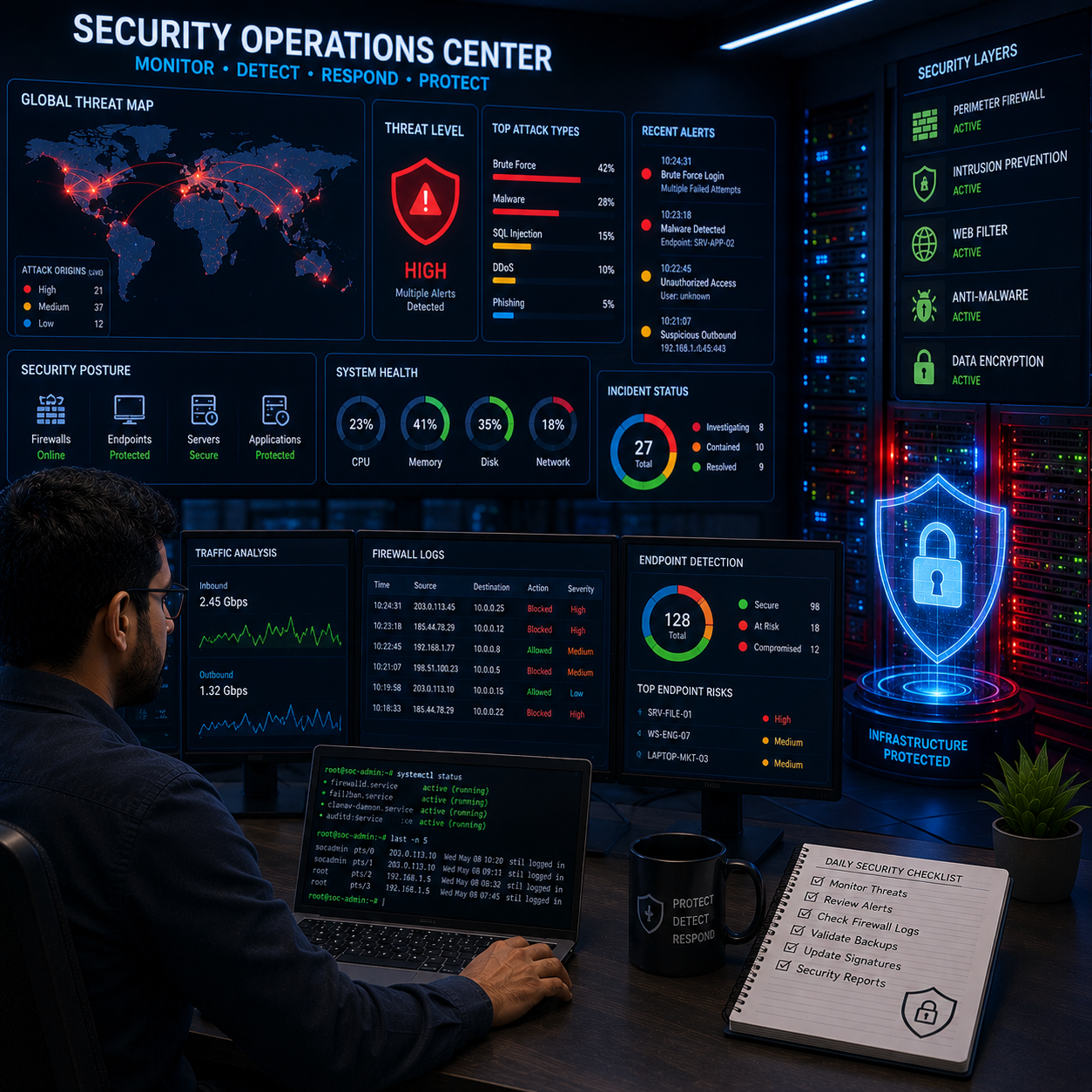
Security Administration of IT Infrastructure course banner
BDT 30,000 BDT 50,000
Installment payment available Pay in 2-3 parts · bKash · Nagad · Bank Transfer
300
Students trained
80%
Exam pass rate
10+ yrs
Training experience
N/A ★
Student satisfaction
Why choose LearnerUp IT
Why choose this course?

Everything you need to get certified

Network Security Fundamentals
Cisco ASA, VPN & Firewall Technologies
Check Point & FortiGate Security
Ethical Hacking & Cybersecurity Skills
Next-Generation Firewall Management
Hands-On Security Lab Practice
Interview Preparation & Grooming
Career-Ready Cybersecurity Skills

Course overview

The Security Administration of IT Infrastructure program is a comprehensive, hands-on training designed to prepare you for securing modern enterprise networks and systems. Covering firewalls, VPNs, next-generation threat prevention, and ethical hacking, this course blends theoretical foundations with intensive practical labs. You'll work on real-world configurations using Cisco ASA, Fortinet FortiGate, and Check Point firewalls, while also learning industry-standard penetration testing techniques. By the end of the course, you'll have the skills and confidence to defend, monitor, and respond to security incidents in enterprise environments.

Who should enroll

Ideal candidates

  • Network administrators looking to specialize in cybersecurity 
  • System engineers aiming to expand into security roles 
  • IT security officers and SOC analysts 
  • Ethical hacking and penetration testing aspirants 
  • IT professionals preparing for vendor certifications like CEH, NSE, CCSA, or CCNP Security

Prerequisites

  • Basic networking knowledge (TCP/IP, subnets, routing concepts) 
  • Familiarity with Windows and/or Linux administration 
  • Understanding of IT infrastructure fundamentals 
  • Prior hands-on experience with network devices is beneficial but not mandatory

Career outcomes

Network Security Administrator 
Firewall Engineer (Cisco ASA, Fortinet, Check Point, Palo Alto) 
SOC Analyst (Tier I / Tier II) 
Cybersecurity Analyst 
Penetration Tester / Ethical Hacker 
Infrastructure Security Specialist 
Incident Response Analyst 
Security Operations Engineer 
Information Security Officer (ISO) 
Threat & Vulnerability Analyst 
IT Security Consultant
COURSE 01: NETWORK SECURITY FOUNDATION (CISCO ASA, VPN, CHECK POINT, FORTIGATE)
Network Security Foundation ( Cisco ASA, VPN, Check Point, FortiGate )
  • Understanding network security architectures and concepts 
  • Cisco ASA Firewall installation and configuration  
  • Access Control Lists (ACLs) and security policy creation  
  • Site-to-Site and Remote Access VPN setup  
  • Check Point Firewall installation and SmartConsole usage  
  • Fortinet FortiGate basic setup and security policies  
  • Troubleshooting firewall traffic flow and NAT policies  
  • High availability (HA) configuration on firewalls
COURSE 02: Certified Ethical Hacker v13
Certified Ethical Hacker v13

Module 01: Introduction to Ethical Hacking 

  • Learn the fundamentals and key issues in information security, including the basics of ethical hacking, information security controls, relevant laws, and standard procedures.

Module 02: Footprinting and Reconnaissance

  • Learn how to use the latest techniques and tools for footprinting and reconnaissance, a critical pre-attack phase of ethical hacking.

Module 03: Scanning Networks 

  • Learn different network scanning techniques and countermeasures.

Module 04: Enumeration 

  • Learn various enumeration techniques, including Border Gateway Protocol (BGP) and Network File Sharing (NFS) exploits and associated countermeasures.

Module 05: Vulnerability Analysis 

  • Learn how to identify security loopholes in a target organization’s network, communication infrastructure, and end systems. Different types of vulnerability assessments and vulnerability assessment tools are also included.

Module 06: System Hacking 

  • Learn about the various system hacking methodologies used to discover system and network vulnerabilities, including steganography, steganalysis attacks, and how to cover tracks.  
    Module 07: Malware Threats

Module 07: Malware Threats 

  • Learn about different types of malware (Trojan, viruses, worms, etc.), APT and fileless malware, malware analysis procedures, and malware countermeasures.

Module 08: Sniffing 

  • Learn about packet sniffing techniques and their uses for discovering network vulnerabilities, plus countermeasures to defend against sniffing attacks.

Module 09: Social Engineering 

  • Learn social engineering concepts and techniques, including how to identify theft attempts, audit human-level vulnerabilities, and suggest social engineering countermeasures.

Module 10: Denial-of-Service

  • Learn about different Denial of Service (DoS) and Distributed DoS (DDoS) attack techniques, plus the tools used to audit a target and devise DoS and DDoS countermeasures and protections. Certified Ethical Hacker Powered by AI Learn

Module 11: Session Hijacking 

  • Learn the various session-hijacking techniques used to discover network-level session management, authentication, authorization, and cryptographic weaknesses and associated countermeasures.  

Module 12: Evading IDS, Firewalls and Honeypots 

  • Learn about firewalls, intrusion detection systems (IDS), and honeypot evasion techniques; the tools used to audit a network perimeter for weaknesses; and countermeasures.  

Module 13: Hacking Web Servers

  • Learn about web server attacks, including a comprehensive attack methodology used to audit vulnerabilities in web server infrastructures and countermeasures.Module

Module 14: Hacking Web Applications 

  • Learn about web application attacks, including a comprehensive hacking methodology for auditing vulnerabilities in web applications and countermeasures.

Module 15: SQL Injection 

  • Learn about SQL injection attack techniques, evasion techniques, and SQL injection countermeasures.

Module 16: Hacking Wireless Networks 

  • Learn about different types of encryption, threats, hacking methodologies, hacking tools, security tools, and countermeasures for wireless networks.

Module 17: Hacking Mobile Platforms 

  • Learn mobile platform attack vectors, Android and iOS hacking, mobile device management, mobile security guidelines, and security tools.

Module 18: IoT Hacking 

  • Learn different types of Internet of Things (IoT) and operational technology (OT) attacks, hacking methodologies, hacking tools, and countermeasures.

Module 19: Cloud Computing 

  • Learn different cloud computing concepts, such as container technologies and serverless computing, various cloud computing threats, attacks, hacking methodologies, and cloud security techniques and tools.

Module 20: Cryptography  

  • Learn about encryption algorithms, cryptography tools, Public Key Infrastructure (PKI), email encryption, disk encryption, cryptography attacks, and cryptanalysis tools.


COURSE 03: NEXT-GENERATION FORTINET FORTIGATE FIREWALL
NEXT-GENERATION FORTINET FORTIGATE FIREWALL

Module 01: Deployment and system configuration

  • Perform initial configuration
  • FortiGate factory default settings
  • FortiGuard licenses
  • FortiGate administrative access
  • FortiGate as a DHCP server
  • System configuration file backup and restore
  • FortiGate firmware upgrades
  • Use cases
  • Configure log settings and diagnose problems using the logs
  • Log workflow
  • Log storage options
  • Device registration on FortiAnalyzer
  • Log message viewing and searching
  • Configure FortiGate Clustering Protocol (FGCP) high-availability (HA) cluster
  • FortiGate HA
  • HA setting modifications
  • Session synchronization for seamless failover
  • HA management interface
  • Typical operation of an HA cluster
  • HA cluster firmware upgrade
  • Use cases
  • Diagnose resource and connectivity problems
  • Abnormal behavior monitoring
  • Physical and network layer problems
  • Connectivity problems—sniffer and debug flow
  • Resource problems—high CPU and memory usage
  • Memory conserve mode
  • Use cases—troubleshoot resource and connectivity problems
  • Describe FortiGate Cloud-Native Firewall (CNF) and FortiGate VMs in the public cloud
  • Threats and challenges in the public cloud
  • Fortinet public cloud solutions
  • FortiGate VMs in the cloud
  • FortiGate CNF
  • Use cases—FortiGate CNF and FortiGate VMs in the cloud
  • Explain FortiSASE administration and user onboarding methods
  • Challenges with remote work
  • Secure access service edge (SASE) architecture
  • FortiSASE components
  • Security features
  • Use cases—FortiSASE

Module 02: Firewall policies and authentication 

  • Configure firewall policies
  • Firewall policies
  • Inspection modes for firewall policies
  • Firewall policy traffic logs
  • Use cases
  • Configure source network address translation (SNAT) and destination network address translation (DNAT) options in firewall policies
  • SNAT configuration
  • Firewall policy to perform DNAT using virtual IP (VIP) addresses
  • Use cases
  • DNAT settings using a VIP
  • Configure different methods of firewall authentication
  • Remote LDAP authentication server on FortiGate
  • Remote RADIUS authentication server on FortiGate
  • Active and/or passive authentication

Module 03: Content inspection

  • Explain and inspect encrypted traffic using certificates
  • Full SSL/SSH inspection for outbound traffic
  • Private certificate authority (CA) certificates on endpoints
  • Certification issues
  • Use cases
  • Identify FortiGate inspection modes and configure web filtering
  • Inspection mode (flow or proxy) based on security needs
  • Certificate inspection for web filtering
  • Web filter profiles in flow-based and proxy-based inspection modes
  • FortiGuard categories
  • URL filters
  • Web filtering issues
  • Use cases
  • Configure application control to monitor and control network applications
  • Application control in profile mode
  • Application control event monitoring
  • Traffic matching with application control profile issues
  • Use cases—application traffic controlling
  • Configure antivirus scanning modes to neutralize malware threats
  • Antivirus profiles in flow-based and proxy-based inspection modes
  • Protocol options
  • Antivirus events—log and monitor
  • Common antivirus issues
  • Configure an intrusion prevention system (IPS) to protect a network from threats and vulnerabilities
  • IPS sensors
  • IPS high-CPU usage issues
  • Use cases—Blocking known exploits

Module 04: Routing

  • Configure and route packets using static routes
  • Static routing
  • Routing table on FortiGate
  • Route redundancy and load balancing
  • Use cases
  • Configure SD-WAN to load balance traffic between multiple WAN links effectively
  • SD-WAN concepts
  • Main use cases for SD-WAN
  • SD-WAN on FortiGate
  • Routing behavior in an SD-WAN context
  • SD-WAN behavior, link usage, and quality status
  • Use cases

Module 05: VPNs 

  • Implement a meshed or partially redundant IPsec VPN
  • IPsec VPN concepts
  • IPsec VPN using the IPsec wizard
  • Redundant VPN between two FortiGate devices
  • IPsec VPNs and review logs
  • IPsec VPN issues
  • Use cases


COURSE 04: INTERVIEW PREPARATION AND GROOMING SESSIONS (SECURITY)
INTERVIEW PREPARATION AND GROOMING SESSIONS (SECURITY)
  • Preparing for technical and HR interviews in cybersecurity roles 
  • Scenario-based firewall and security troubleshooting 
  • Resume and LinkedIn profile optimization for security jobs 
  • Communication and presentation skills for security topics 
  • Workplace professionalism and ethical standards in security roles
Nur Hossen
Nur Hossen
Head Of Department

With over 16 years of experience in the information technology field, I have built a strong specialization in banking technology and have worked with a wide range of corporate groups and government sectors, including my current role serving the Ministry of Defense in Kuwait.My expertise spans across systems security, information systems auditing, data center management, and IT project management. I am deeply committed to delivering secure, scalable, and efficient technology solutions tailored to organizational needs.

Windows system Administration

More instructors at LearnerUp IT

Kushal Kabi
Kushal Kabi
Sr. Technical Trainer
Windows system Administration
Abdullah Al Mahbub
Abdullah Al Mahbub
Sr. Technical Trainer
Windows system Administration
Razya Akter
Razya Akter
Sr. Technical Trainer
Windows system Administration
View all instructors at LearnerUp IT →
N/A
★★★★★
0 ratings
5★
0
4★
0
3★
0
2★
0
1★
0

Leave a Review

Review Submitted Successfully

Thank you for sharing your experience with LearnerUp IT. Your review will be visible after approval.

What kind of support will I receive during the course?
LearnerUp provides end-to-end support throughout your learning journey. Students receive guidance from certified instructors, access to study materials and hands-on labs, and dedicated academic and technical assistance. Career support, including CV building, interview preparation, and placement assistance, is also available for diploma and job-guarantee programs.
What types of courses does LearnerUp offer?

LearnerUp delivers training across five specialized departments:

  • Network Administration (CCNA, CCNP, MikroTik, Juniper, OLT, Infrastructure Diploma)
  • Windows System Administration (Windows Server, PowerShell, Infrastructure Diplomas)
  • Linux System Administration (RHCSA, RHCE, Infrastructure Diplomas)
  • Security Administration (Firewalls, CEH, Penetration Testing, Security Diplomas)
  • Cloud Administration (AWS, Azure, Cloud Infrastructure Diplomas)
Do the job-guarantee programs guarantee a job for all students?
Our Job-Guarantee Diploma Programs are designed to make you industry-ready through practical labs, real-world projects, and interview preparation. While no institute can guarantee employment for every student, LearnerUp ensures robust placement assistance, career mentorship, and industry connections to maximize your chances of securing a job.
Are there Scholarship courses available?

Yes. LearnerUp provides several scholarship-based courses to help students start their IT journey:

  • CCNA Crush Course
  • MTCNA Crush Course
  • IT Support & Services
  • Network Engineering Essentials
  • Microsoft Windows Server Engineering Essentials
  • Red Hat Linux Server Engineering Essentials
  • Security Engineering Essentials
Does LearnerUp provide free demo classes?
Yes. LearnerUp offers free demo classes so you can experience our teaching style, lab facilities, and course structure before making a decision.
Are the instructors at LearnerUp certified?
Yes. All our trainers are industry-certified professionals (Cisco, Red Hat, Microsoft, AWS, EC-Council, MikroTik, etc.) with extensive real-world experience. They combine certification expertise with practical insights to prepare you for both exams and job roles.
Does LearnerUp offer installment options?
Yes. To make learning accessible, we allow students to pay in convenient installments across all certification and diploma programs.
Who should enroll in LearnerUp's job-guarantee courses?

Our job-guarantee diploma programs are best suited for:
  • Fresh graduates aiming to start an IT career
  • Polytechnic, diploma, or engineering students
  • Professionals seeking a career switch into IT
  • Learners who want structured, career-oriented training with placement support
Do they offer corporate or customized training programs?
Yes. LearnerUp delivers corporate and customized training programs tailored for businesses. We specialize in workforce upskilling in networking, security, cloud, and system administration to meet organizational requirements.